The Home as a Legacy Factory

During the college football playoffs, pictures like the one below kept making their rounds in my news feed. Apparently, every head coach in the final four playoff teams had previously been an assistant at Alabama under head coach Nick Saban, who is considered one of the greatest football coaches of all time. His coaching tree included 5 coaches in the College Football Playoffs.

This level of success in football is a great reminder that it matters who you surround yourself with and seek to learn from. It matters who you look up to--who you seek to be your mentors or role models--because we start to take on the characteristics and quirks of those we surround ourselves with. As an older gentleman in our previous church would say, “It’s hard to fly with the eagles when you’re surrounded by turkeys.” The Bible puts it this way:
“Do not be deceived: “Bad company corrupts good morals.”
The opposite is also true. Good company fosters good morals.
As parents, this is a real-life, down-to-earth, universal law we need to take advantage of! Statistics have long revealed that on average:
· 15% of a child’s waking hours is spent at school.
· 1% is spent in Sunday school or youth group.
· However, roughly 84% is spent at home.
By sheer mathematics, children spend most of their waking time with parents. We can conclude, then, that parents have the most influence over their children. The home will be far more impactful than anything else in their lives!
What this means is that it’s not enough to just send my kid to Sunday school, youth group, or a Christian camp (as important as those things are in their faith journey) and expect those places to teach them all they need to know about God and faith. They need to have it taught and modeled in the home. This is why Dallas Theological Seminary instructor, Howard Hendricks, would say, "Heaven help the home!"[1]
In my last blog piece, I talked about how many students are “going to college and leaving church behind” because they aren’t being prepared for the intellectual onslaught against Christianity on the college campus. Another reason they may “leave church behind” is because they aren’t seeing faith lived out in the home. They’re going to church on Sunday but there is no spiritual culture in the home. So, when they’re old enough, they do what human nature tends to do—it rebuffs against hypocrisy and the lack of humility.
God’s plan from the beginning was for the home to be a legacy factory for faith.[2] Deuteronomy 6:4-9 reminds us that parents are central to God’s plan for multigenerational faithfulness.
4 “Hear, O Israel! The LORD is our God, the LORD is one! 5 And you shall love the LORD your God with all your heart and with all your soul and with all your strength. 6 “These words, which I am commanding you today, shall be on your heart. 7 You shall teach them diligently to your sons and shall talk of them when you sit in your house and when you walk by the way and when you lie down and when you rise up. 8 You shall also tie them as a sign to your hand, and they shall be as frontlets on your forehead. 9 “You shall write them on the doorposts of your house and on your gates.”
This portion of Deuteronomy is what the Jewish people call the “Shema” and what pious Jews repeat twice daily. It is the instruction God gave to the Israelites for passing on the faith to the next generation. How will the next generation love the Lord with all their being? By talking about the things of God without ceasing. That doesn’t mean you can’t talk about anything else or read anything other than the Bible. It means that He should be the primary object of our worship and affection, which means that from sunup to sundown, we can and should look to teach our children about the works of God and the Word of God. They should be taught diligently (v. 7) in both formal and informal ways.
Informal Teaching
Teh emphasis in this passage appears to be on the informal, which means they don’t always have to be sitting down in a classroom listening to lectures. Some of our greatest conversations with our kids about God and truth happened while on a walk or driving or cooking or working in the garden. Sometimes they ask random questions out of the blue. Sometimes they come across something new to them and want to learn more.
But be on the lookout for teachable moments. Do you see a rainbow? Why not teach them or remind them of God’s rain “bow” from Genesis 9? Do you see a person in need of immediate assistance? Run over and lend them a hand. Show them how it’s done as a “Good Samaritan” would! Sometimes more is caught (by example) than taught (formally). Does the family have a need? Pray together for God to meet it.
Not too long ago I went to buy steaks for my wife’s birthday. After I paid for them, I thought, “Well that seemed a little cheap.” After reviewing the receipt, I realized they forgot to scan one of the steaks. What do you do in that situation? Beef ain’t cheap! I’m glad to say that at that moment, I did the right thing and it was a teachable moment for my daughter who was with me. I asked her what she thought most people would do in that situation. She said “They wouldn’t tell the cashier and be happy about it.” And then I said, “What do you think God wants us to do?” Her reply was one to be proud of. “He would want us to be honest… I want to do the right thing too when I grow up.”
On another occasion, I didn’t do the right thing. I can’t remember the exact set of circumstances, but I was upset about something frivolous. It obviously wasn’t all that important because I can’t even remember it! But I do remember the brutally honest words of my daughter who said, “Dad, I don’t think you’re thinking about Jesus right now.” She was right. I had to repent and apologize for not representing Jesus well or trusting Him with the situation. See, we don’t need to be perfect as parents. There’s no such thing as perfect parents. But we do need to do the next right thing and set an example by admitting when we’re wrong. In that moment it was too late to model a good attitude throughout the situation, but I could still pass on what it looks like to have a humble, repentant heart, which is possibly even more important.
Teaching Through Repeated Exposure
Before I wrap it up, there is something to be said from this verse about teaching through repeated exposure. All day, every day, the Jewish people were to surround themselves with truth. It should be in them and on them and around them. In their hearts. On their foreheads. On their hands. On their lips. On their mind. Doing this would help them walk faithfully with their God because 1) as forgetful humans do, we get off track fast when God’s Word is not on our heart or mind, and 2) repetition is the mother of all knowledge.
Right now, many youths (and everyone else for that matter) are surrounded constantly by useless games or garbage videos—and please excuse me for being blunt, but it shows! When we are repeatedly exposed to something, it becomes part of who we are. We internalize it. We memorize it. We live it. Therefore, Deuteronomy 6 encourages the Israelites to surround themselves with God's Word by writing it on the gates and doorposts of their houses.
J. C. Ryle (ca. 1816-1900) is an old English preacher that I’ve enjoyed studying and reading about. He took this verse literally and had Bible verses written all over the walls of his church with some of the important words in red. On the arch in the front of the church he had written, “Being justified by faith we have peace with God through our Lord Jesus Christ” (Rom. 5:1). On the wall beside his pulpit, it was written, “Woe unto me if I preach another gospel” (I Cor. 9:16). On another wall was written, “It is written there is none righteous, no not one” (Rom. 3:10). Several verses can be seen in the worship center pictured below.

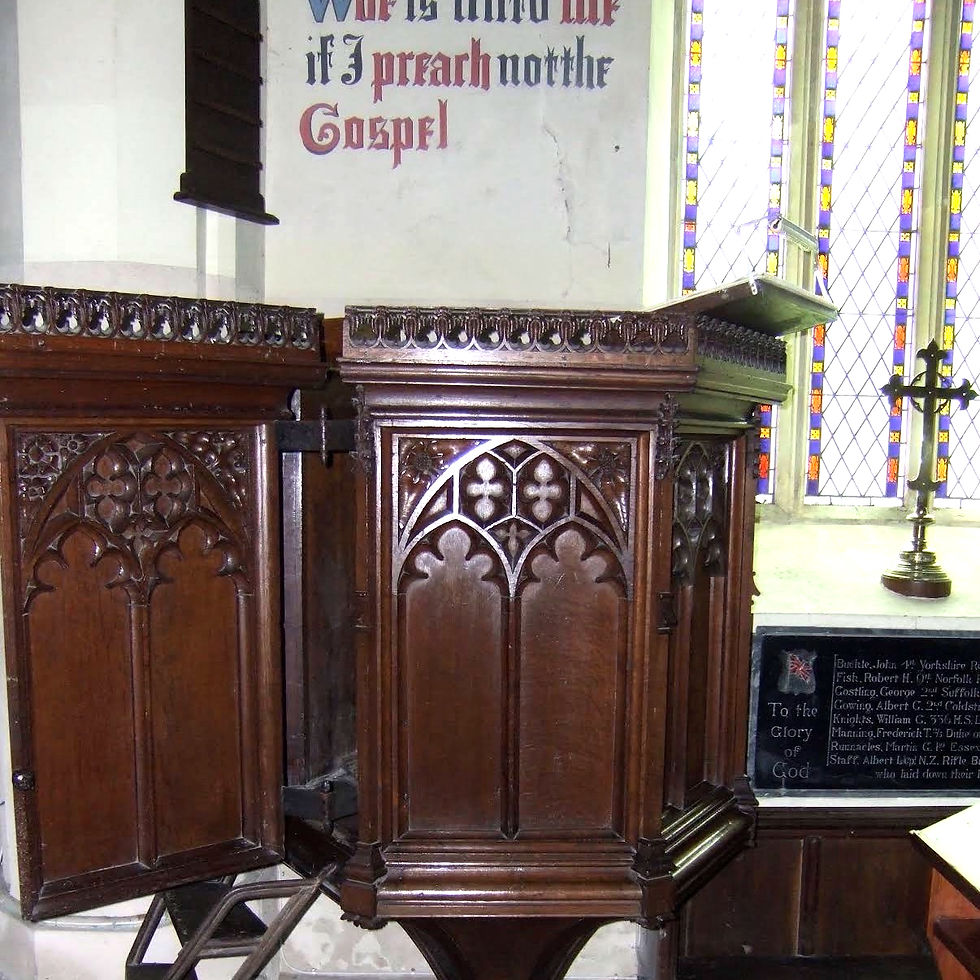
Like Ryle’s church or the Israelites’ homes, we too can learn through frequent exposure. This is why I have ABC Youth’s core values and mission statement on the youth room walls. It’s why we have a chalkboard or a whiteboard at home where we write verses that we want to memorize together as a family. I know of others who have had Bible verses painted or stuck on their walls with vinyl decals. These tools help us memorize verses long term.
As parents, we are the biggest shapers of our children. Are we what we want them to become? Do we possess what we seek to impart? Do they see us spending time in God’s Word, in prayer, and living out the Gospel? This is the greatest legacy we can pass on.
[1] Howard Hendricks, Heaven Help the Home! (Wheaton, IL: Victor Books, 1973, 1990).
[2] Ibid.


Comments